Balancing Act: HRV Provides Critical Marker for Psychophysiological Health

Two college wrestlers square off on the mat awaiting the signal that will begin their match. To the casual observer, the outcome seems impossible to predict. Their coach, however, knows one competitor has a clear advantage—a heart rate variability level (HRV) that is higher than his opponent’s. Examining HRV data provides more than insight into athletic performance, it offers a window into a broad spectrum of functions that influence psychophysiological health.

HRV balanceIn simple terms, HRV is the natural variation in the intervals between each heartbeat over time. Unlike a ticking clock, our hearts do not beat at a constant rate. As such, variations in heart rate can provide a wide range of valuable information on our bodily systems. This is because HRV represents a balancing act between our sympathetic and parasympathetic nervous systems, which together make up the autonomic nervous system. As we have discussed in previous posts, the autonomic nervous system controls nearly all the body’s involuntary functions.

The sympathetic nervous system is activated in times of stress or danger (i.e., the fight-or-flight response), during which our bodies sweat, our heart rates increase, and the interval between beats decreases. Conversely, the parasympathetic nervous system acts as a sort of switch, shutting down the sympathetic nervous system and activating a relaxed state (i.e., rest and digest). To do this, it releases acetylcholine, a neurotransmitter that makes the heart beat slower and at greater intervals.

When these two systems are in balance, they produce higher HRV through a more variable heart rate. Greater variability has been associated with the body’s ability to switch between these systems. Thus, HRV is used as a health marker, such that high HRV is associated with better cardiovascular health, mental focus, emotional health, stress management, and ability to recover from exercise, while low HRV is associated with inflammation, chronic fatigue, increased stress, depression, and chronic pain.

HRV has also been connected to willpower and is a predictor of persistence and self-control. HRV increases during periods of self-regulation sometimes called the “pause and plan response.” As such, HRV has been particularly useful in research into the mechanism associated with addiction. A 2019 study used HRV to explore how chronic pain patients treated with opioids could regulate drug cravings and depression through dispositional mindfulness. Electrocardiogram (ECG) data were sampled with a BIOPAC data acquisition unit while HRV was calculated with AcqKnowledge software.HRV chart

Because HRV plays such a critical role in physical and psychological health, several studies have investigated how to self-regulate HRV, including examining how it is affected by posture. A 2020 study used a  2-channel BSL data acquisition unit to gather ECG data to calculate HRV for a variety of bodily positions to determine their impact.

A similar study examined the link between HRV and resilience, i.e., the individual’s ability to return to stable physical and psychological equilibrium after experiencing stress. HRV calculations were made from data gathered via a BIOPAC ECG100C ECG amplifier, RSP100C respiratory amplifier, and EDA/GSR amplifier. The study identified possible trends connecting resilience factors and HRV levels during specific stress-inducing simulations.

Calculating HRV with BIOPAC hardware and software solutions provides researchers with a myriad of psychophysiological insights for their lab work. Learn more about HRV from our Knowledge Base entry, as well as application notes on data preparation for analysis and statistical and geometric measures.


For additional information on how BIOPAC can assist you with a wide range of research and educational applications, contact your local sales representative.


Holiday Happiness Part 2: Sounds, Smells, and Self-Reflection

In a previous post, we discussed the stress-reducing benefits of loving interactions with close friends and family during the holiday season. In addition to family, there are many mood-shaping habits and activities that characterize the holidays: the smell of home-cooked meals, seasonal music, and reflection on the past year, to name a few. But do these have a real impact on happiness?

In a psychophysiology study, Matsunaga, et al., tested odor effects on autobiographical memory recall. The researchers introduced several odor stimuli to participants and measured their psychological and physiological reactions. Heart rate and skin conductance were recorded throughout the experiment with a BIOPAC data acquisition system. The odor stimuli resulted in decreased heart rate, increased skin conductance level, and an increase in positive mood states.

Another article tested the effects of meditation on emotional regulation. Participants completed emotional measures before and after a meditation intervention, and had their ECG, respiration, and blood pressure recorded using a BIOPAC MP unit. The meditation correlated with greater participant emotional regulation, as suggested by lower heart rate and respiration.

In addition to meditation and smell, Harmat and Eerola have found music to also be emotionally significant. Participants listened to a musical piece, and then responded to a questionnaire about their emotional state. In addition to measuring pulse rate and facial expressions, the BIOPAC Research System and EDA Amplifier were used to record skin conductance while participants listened to the stimulus. The results found that music samples evoked several emotions, including nostalgia and happiness.

This research suggests that we can affect happiness using subtle techniques that are part of everyday living. To read more studies about psychophysiology and stress reduction, visit the BIOPAC publication page.

BIOPAC offers a variety of equipment that can be used in studies similar to the ones presented. To find more information on solutions for recording and analyzing signals such as skin conductance, ECG, heart rate, respiration, and EDA using the MP160/MP150, and other platforms, you can visit the individual application pages on the BIOPAC website. 

The Physiology of Consumer Buying Habits

On “Black Friday” in the US, shoppers will come out in search of great deals, and researchers can measure the many physiological factors that motivate shoppers other than deals and price cuts.

Black Friday is one of the most exciting days for consumers in the United States. With the holidays right around the corner, significant deals and price cuts incentivize people to do bulk gift shopping. But is price the only factor influencing shoppers to dedicate hours waiting in line for a product?

In a neurophysiology study by Alexander et al., researchers found that participants who received a coupon while shopping online had a significant increase in oxytocin and a decrease in cortisol. A BIOPAC research system was used to gather ECG, respiration, and skin conductance data while the participants browsed a commerce website.

Another article by Ha-Brookshire and Bhaduri measured ECG response to stimuli that tested consumers’ perceived trust of businesses. The BIOPAC MP36R was used to record participants’ heart rates while they read negative reviews of an apparel business. The results found lower heart rate and less trust were correlated with the less favorable comments.

Conversely, a consumer research study by Langner et al. found that consumers’ love of brands is similar to their love of friends. Signals measured included EDA, EMG, ECG, and BPV, and were recorded by BIOPAC MP160/MP150 hardware to measure arousal levels while participants viewed different brand and interpersonal stimuli.

BIOPAC offers a variety of equipment that can be used in studies similar to the ones presented. To find more information on solutions for recording and analyzing signals such as EEG, EMG, respiration, skin conductance using the MP160/MP150, MP36, and other platforms, you can visit the individual application pages on the BIOPAC website. If you are interested in reading other related studies, visit the publications page on the BIOPAC website.

BIOPAC Systems, Inc. provides life science researchers and educators with data acquisition and analysis systems that inspire people and enable greater discovery about life. Visit us at www.biopac.com.

The Physiology of Election Decision-Making

The psychophysiological factors of stress, the behaviors of others, and of introception can play major roles in decision-making, and BIOPAC systems provide measurements of how physiological factors such as these influence decisions.

People experienced varying stress levels because of the 2016 US presidential election. There are a variety of factors that can impact voting behaviors and decision-making. Several recent studies using BIOPAC systems investigated the psychophysiological effects of stress, the behaviors of others, and introception on decision-making.

Stress has been shown to be very influential in decision-making. In their study, Yamakawa, Ohira, and Mastunga Isowa (2016) investigated effects of acute stress and risk taking in decision-making. Participants were asked to perform a decision-making choice where they either kept or bet the money they were given. Cardiodynamic activity was measured with ECG using a BIOPAC MP system. Results suggest that with an increase in cortisol, adrenaline, heart rate, and subjective stress, participants were likely to make fewer risky choices. So, high levels of stress may be key in helping make better decisions when selecting a future president.

Perhaps it’s not stress that will influence the choice of the next POTUS (President of the United States), but rather the behaviors of others. Work by Bault, Joffily, Rustichini, and Coricelli (2011) sought to compare private and social decision-making to discover the effect of social comparison on risky choices. The objective of the study was to understand more about how individuals evaluated the outcomes of their decisions in private as opposed to in a social context. Combining data from functional MRI (FMRI) and skin conductance recordings, subjects’ reactions were measured using a BIOPAC MP150 System. Researchers found that participants took significantly longer to make a decision in a social setting than in a private one.

In the end, many feel that it is important to listen to your heart when deciding who you find qualified to be the next president. A study by Dunn et al. (2010) examined whether introception moderates the coupling of bodily responses to emotional experience and intuitive decision-making. Bodily response and heart rate were recorded using a BIOPAC Research System and electrodes to measure introception through changes in heart rate. Researchers found that introception was not related to arousal, valence ratings, or heart rate response to images.

For more information on BIOPAC’s wide range of tools for recording, displaying, and analyzing physiological measurements from human and animal subjects including respiration, heart rate variability, ECG and EDA, visit BIOPAC’s  psychophysiology page and view BIOPAC’s full line of electrodes, amplifiers, and wearable, wireless transmitters and loggers.

BIOPAC Systems, Inc. provides life science researchers and educators with data acquisition and analysis systems that inspire people and enable greater discovery about life. Visit us at www.biopac.com.

Respiration and ECG

By Alan Macy, BIOPAC Systems, Inc. The mechanical relationship between the diaphragm and heart and Respiratory Sinus Arrhythmia (RSA). are two influences of respiratory activity on the electrocardiogram (ECG).

By Alan Macy, BIOPAC Systems, Inc.

There are two influences of respiratory activity on the electrocardiogram (ECG). The first influence is characterized by the mechanical relationship between the diaphragm and heart. The second influence is a consequence of respiratory action on the vagus nerve and is known as Respiratory Sinus Arrhythmia (RSA).

  1. The position and movement of the diaphragm determine the position of the heart because the pericardium is firmly attached to the central tendon of the diaphragm. With deep inspiration, the diaphragm contracts and becomes flatter and less dome-shaped. As it does, the heart descends, moves backward, and rotates to the right so that it becomes narrower and more vertical. The apex beat is lower and more medial. During deep expiration, the diaphragm relaxes, elevates, and becomes more dome-shaped, and movements of the heart are the converse of those that occur during deep inspiration. The degree of the directional movements of the heart during quiet breathing is similar, but reduced, compared to deep breathing and, in some persons, may be hardly noticeable. Diaphragmatic breathing cyclically affects the position of the heart, thus modifying the ECG.
  2. Heart rate increases during inhalation and decreases during exhalation. Heart rate is normally controlled by centers in the medulla oblongata. One of these centers, the nucleus ambiguus, increases parasympathetic nervous system input to the heart via the vagus nerve. The vagus nerve decreases heart rate by decreasing the firing rate of the sinoatrial (SA) node. The SA node is the “pacemaker” of the heart. Upon expiration, the cells in the nucleus ambiguus are activated and heart rate slows down. In contrast, inspiration triggers inhibitory signals to the nucleus ambiguus and consequently the vagus nerve remains unstimulated. When recording the ECG, this phenomenon is experienced as subtle changes in the R-R interval that appears synchronized with respiration. This is the time period between two “R” waves on an electrocardiogram. The R-R interval associated with the ECG is shortened during inspiration and prolonged during expiration.

For more information on BIOPAC’s wide range of tools for recording, displaying, and analyzing ECG measurements from human and animal subjects including respiration, heart rate variability, and RSA, visit BIOPAC’s electrocardiography pages and view BIOPAC’s full line of electrodes, amplifiers, and wearable, wireless transmitters and loggers.

BIOPAC Systems, Inc. provides life science researchers and educators with data acquisition and analysis systems that inspire people and enable greater discovery about life. Visit us at www.biopac.com.

Circumplex Model of Affect and Motivational State

By Alan Macy, BIOPAC Systems, Inc.

The Circumplex Model of Affect was first described in 1980 by James Russell. Affective states arise from the behavior of two independent neurophysiological systems, the arousal and valence systems. Affective states are a function of these two systems. The circumplex model is two-dimensional, with arousal and valence defined as orthogonal (perpendicular) axes. The arousal axis, plotted vertically, ranges from zero arousal to high arousal.The valence axis, plotted horizontally, ranges from negative to positive. Objective physiological indexes of affect or emotion are available. As valence examples, positive affect is indicated by increasing zygomaticus activity and negative affect is indicated by increasing corrugator activity. Physiological example indices for arousal include heart rate and electrodermal activity.

Perhaps even more fundamental to emotional state is the concept of motivational state. Motivational state is indexed by specific, bodily expressed, physiological states that can easily be measured. Motivational state is based on the concept of core relational themes, called “challenge” and “threat”.  During the course of living, humans relate to difficult environmental circumstances as a combination of challenge and threat. A challenge response is similar to the aerobic physiological response and involves increased stroke volume and cardiac output, unchanged or increased heart rate, decreased vascular resistance and relatively unchanged blood pressure. This response is indicative of efficient mobilization of available energy for coping with circumstances. A threat response is characterized by increased heart rate and blood pressure, increased or little changed vascular resistance, decreased or unchanged stroke volume and relatively unchanged cardiac output. A challenge response occurs when the subject experiences sufficient resources to meet circumstantial demands in a performance situation where goals are important. A threat response occurs when the subject experiences insufficient resources to meet those same circumstantial demands. If a circumstance is determined to be challenging, then subject performance is usually adequate. If a circumstance is determined to be threatening, then subject performance tends to worsen. Motivational state information can be used to better reflect objective differences between similar circumplex model defined emotions, such as anger and fear.

Electrodermal activity (EDA) is a physiological signal that indicates increased SNS activity. EDA is representative of changes in the electrical conductance of the skin due to eccrine (sweat) gland activity. SNS activity increases sweat gland secretions. Eccrine glands only receive activation signals from the SNS, so increased EDA is an indicator of increased arousal.

Skin temperature (SKT) changes are primarily driven by variations in blood flow. These local variations are mainly caused by changes in vascular resistance or arterial blood pressure. Local vascular resistance is modulated by smooth muscle activity, which is mediated by the SNS. SKT variation reflects SNS activity, and is an indicator of emotional state.  In particular, fingertip temperature is a marker for sympathetic induced changes in microcirculation.

Blood Volume Pulse (BVP), also referred to as the Pulse Plethysmogram (PPG), is reflective of variations in microcirculation. As vasculature resistance to flow increases, subject to increased SNS, microcirculation decreases. Accordingly a reduction in PPG (BVP) amplitude reflects increased SNS activity.

The heart and brain are connected bidirectionally via the vagus nerve. Vagal PsNS stimulation, from the brain, influences the heart via the sino-atrial (SA) node. Baroreceptor signals, from the heart, travel back along the vagus nerve to affect the brain. The SA node is the pacemaker of the heart. The SA node receives inputs from both the SNS and PsNS. The SA node can be considered to be a spike-train generator whose inter-spike (firing) interval is modulated by both SNS and PsNS activity levels. Because both SNS and PsNS activity influence SA node spike firing, heart rate behavior can be considered to be dependent on a range of emotional states. SNS activity increases heart rate and PsNS activity decreases heart rate.

Heart rate variability (HRV) is a measure of heart rate changes over time. HRV has a frequency range of 0.003 to 0.4 Hz and is considered to have four sub-bands:  HF, LF, VLF and ULF. High frequency HRV (HF-HRV) band power is in the range of 0.18 to 0.4 Hz and reflects primarily PsNS influences. HF-HRV band power reflects modulation of vagus nerve activity, as driven by respiration. This modulation is called respiratory sinus arrhythmia (RSA). Low frequency HRV (LF-HRV) band power is in the range of 0.05-0.15 Hz and appears to reflect both SNS and PsNS influences. Very low frequency HRV (VLF-HRV) band power is in the range of 0.003-0.05 Hz and may reflect cardiovascular disease, thermo-regulatory cycles and blood plasma renin activity. Ultra low frequency HRV (ULF-HRV) band power is in the range of DC-0.003 Hz and may reflect circadian rhythm activity.

PsNS influences occur over the LF and HF frequency ranges of HRV. SNS influences drop off at about 0.15 Hz and higher. PsNS influences can affect heart rate in a fraction of a second, but SNS influences can only affect the heart rate after a few seconds. Accordingly, PsNS influences are uniquely capable of producing high speed changes in the heart rate. PsNS innervation of the heart is controlled by the right vagus nerve via the SA node. PsNS induced changes in heart rate are associated with vagal nerve activity that is modulated by respiration. Expiration causes an increase in vagal nerve activity, so heart rate decreases. Inspiration causes suppression of vagal nerve activity, so heart rate climbs back up. This combined action is known as respiratory sinus arrhythmia (RSA). RSA is considered, in part, to be a marker for vagal control of heart rate and also for emotional regulation. Total HRV appears to be positively correlated with valence.

When attention increases, there is a short term deceleration of heart rate. Arousal is also correlated to a long term acceleration in heart rate. Heart rate also provides an indication of valence. Compared to neutral stimuli, both positive and negative stimuli first exhibit a short term decrease in heart rate. Over the long term, positive stimuli are correlated with an increase in heart rate while negative stimuli usually are correlated to a decrease in heart rate.

Respiratory activity occurs via periodic contraction and relaxation of respiratory muscles, including the diaphragm, intercostal and abdominal muscles. The motor outputs for controlling respiration are generated by efferent neurons in the spinal cord.  There are autonomic and voluntary breathing pathways to these respiratory-related efferent neurons. A variety of afferent (sensory) inputs influence respiratory rate and tidal volume in support of the body’s metabolic demands. SNS activity increases respiratory rate and PsNS activity reduces respiratory rate.

Several EEG studies suggest that emotional valence is linked to frontal lobe activation, typically indexed by alpha power. Positive valence is correlated to increased activation of  the left frontal lobe and negative valence is correlated to increased activation of the right frontal lobe.  Other studies have suggested that frontal lobe EEG activation asymmetry reflects the relative balance of motivational state, more so than emotional valence.  In this work, enhanced left frontal lobe activation predicted dispositional states towards challenge and enhanced right frontal lobe activation predicted dispositional states towards threat.

Artwork adapted from from Russell, J. A. (1980). A circumplex model of affect.Journal of Personality and Social Psychology, 39, 1161–1178.

For more information on BIOPAC’s wide range of tools for recording, displaying, classifying, and analyzing psychophysiological measurements—including EEG, ECG, EDA, PPG, and emotional states—visit BIOPAC’s applications pages and view BIOPAC’s full line of physiology data acquisition and analysis systems, electrodes, amplifiers, and wearable, wireless transmitters and loggers.

BIOPAC Systems, Inc. provides life science researchers and educators with data acquisition and analysis systems that inspire people and enable greater discovery about life. Visit us at www.biopac.com.


Impedance Cardiography

By Alan Macy, BIOPAC Systems, Inc.

ICG is a measurement method that is primarily used to determine aspects of Cardiac Output (CO).   CO is the total amount of blood, pumped from both the left and right ventricles of the heart for each of its successive systolic phases, over the course of one minute.  The systolic phase, or systole, is when the heart muscle contracts and pumps blood from the chambers (left and right ventricles) into the arteries.  Typical resting cardiac output is 4.9 liters/minute for an adult human female and 5.6 liters/min for an adult human male.

Left ventricular cardiac output is the CO from the left ventricle only and can be estimated via a non-invasive technique called Impedance Cardiography (ICG), which provides an approximation of Stroke Volume (SV).  If SV and Heart Rate (HR) are known, then CO can be determined by:


SV * HR = Cardiac Output


ICG is measured by introducing a constant current (I) through the thoracic volume and then measuring the resulting voltage (V).   The following equation is used to determine thoracic impedance (Z).

 Z = V/I

 Where V and I are the root mean square (rms) values of the measured voltage and supplied (known) current.  ICG systems induce a constant magnitude, alternating current (I) through the thorax via electrodes.  A separate set of electrodes (placed between the current electrodes) monitor the voltage (V) developed across the thorax.  Because the magnitude of I is constant, V will vary in direct proportion to Z.


The applied current (I) flows through the volume of the thorax, which includes skin, skeletal muscle, the lungs, the heart and blood.  Because blood is a conductor, the changes in blood volume during a cardiac cycle produce a measurable change in thoracic impedance.  Researchers have developed equations for estimating left ventricular SV based on thoracic impedance, with the most widely used equation being that developed by Kubicek, et al. (1966):

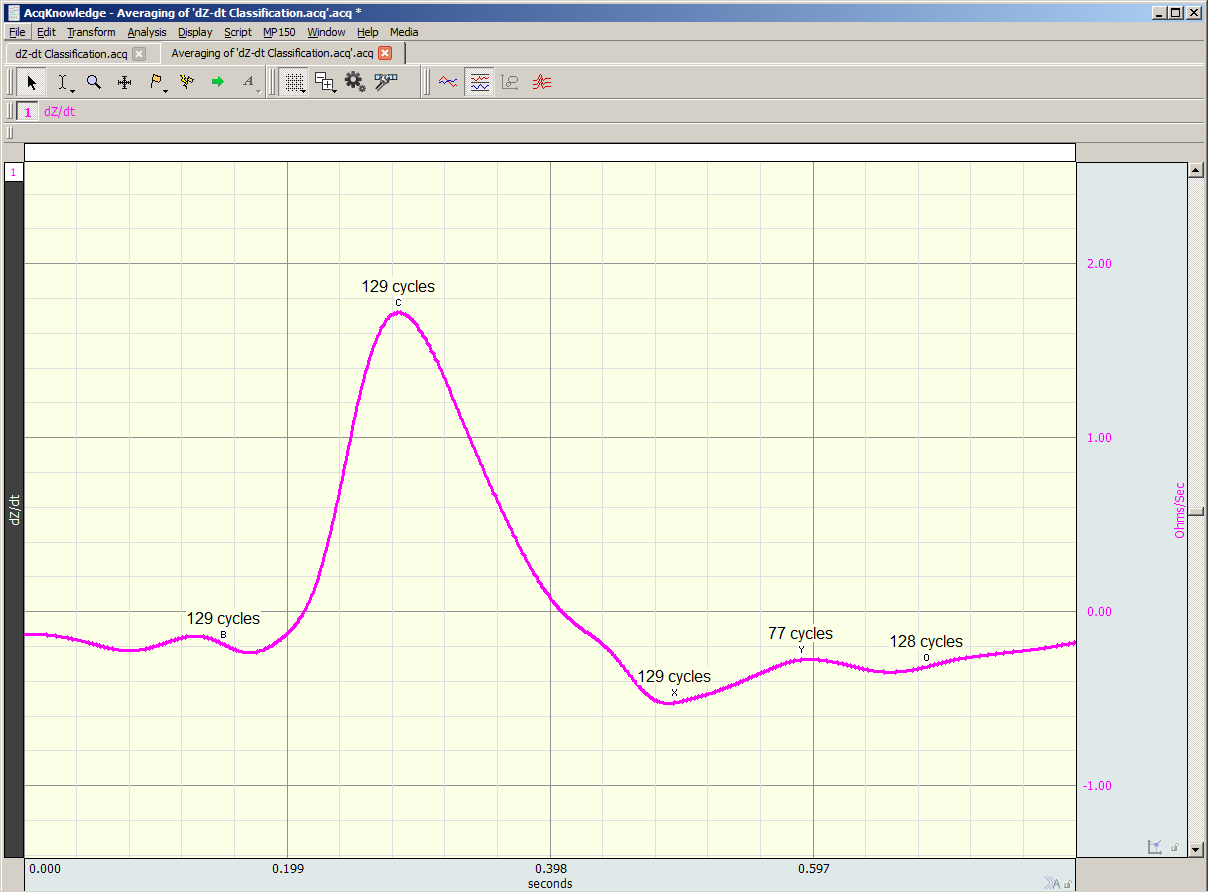
 SV = rho x (L/Zo)² x LVET x (dZ/dt Max)

 Where:

 SV = Stroke volume (ml)

rho = Resistivity of blood (Ohms·cm) which is assumed to be a constant 135 Ohms·cm (Quail, Traugott, Porges, & White, 1981).

L = Length or distance between inner band (voltage monitoring) electrodes (cm)

Zo = Basal Thoracic Impedance (Ohms)

LVET = Left Ventricular Ejection Time (seconds)

dZ/dt Max = Absolute value of the cyclic peak of the derivative of Zo (Ohms/sec)

LVET varies inversely with heart rate under a broad range of circumstances.  LVET should not be treated as a constant in the Kubicek equation.  Unlike Length (L), which is constant during a session, Thoracic Impedance (Zo) also varies some, although not as much as LVET.   Blood resistivity (rho) also may vary with changes in hematocrit levels and red blood cell orientation, but that variation has largely been ignored because of the difficulties associated with having to draw blood to measure rho.

Impedance Cardiography (ICG) is an indirect measurement of Stroke Volume (SV).  Studies have been performed to correlate ICG to SV, using thermodilution as reference and have found that accuracy improves when variables such as age, height, sex, waist circumference and weight are factored into the SV estimation.  Accordingly, ICG measures are best interpreted as a relative, versus absolute, indication of SV.  Even so, as a relative measure, ICG can provide a clear indication of important physiological processes associated with homeostasis and hemodynamic changes.

Research in psychophysiology, and other areas of physiology, focuses on the left ventricle because it pumps blood that supplies the metabolic requirements of striated (skeletal and cardiac) musculature and thus fundamentally supports behavior and exercise.  For Impedance Cardiography (ICG), the left ventricle is principally important because the dZ/dt signal primarily indicates left ventricular blood ejection into the aorta.  There is very little influence from right ventricular blood ejection in the ICG signal.

For more information on BIOPAC’s ECG solutions, visit BIOPAC’s ECG-Cardiology page or view BIOPAC’s full line of electrodes, amplifiers, and wearable, wireless transmitters and loggers.

For more information on BIOPAC Systems, visit us at www.biopac.com.

error: Content is protected !!