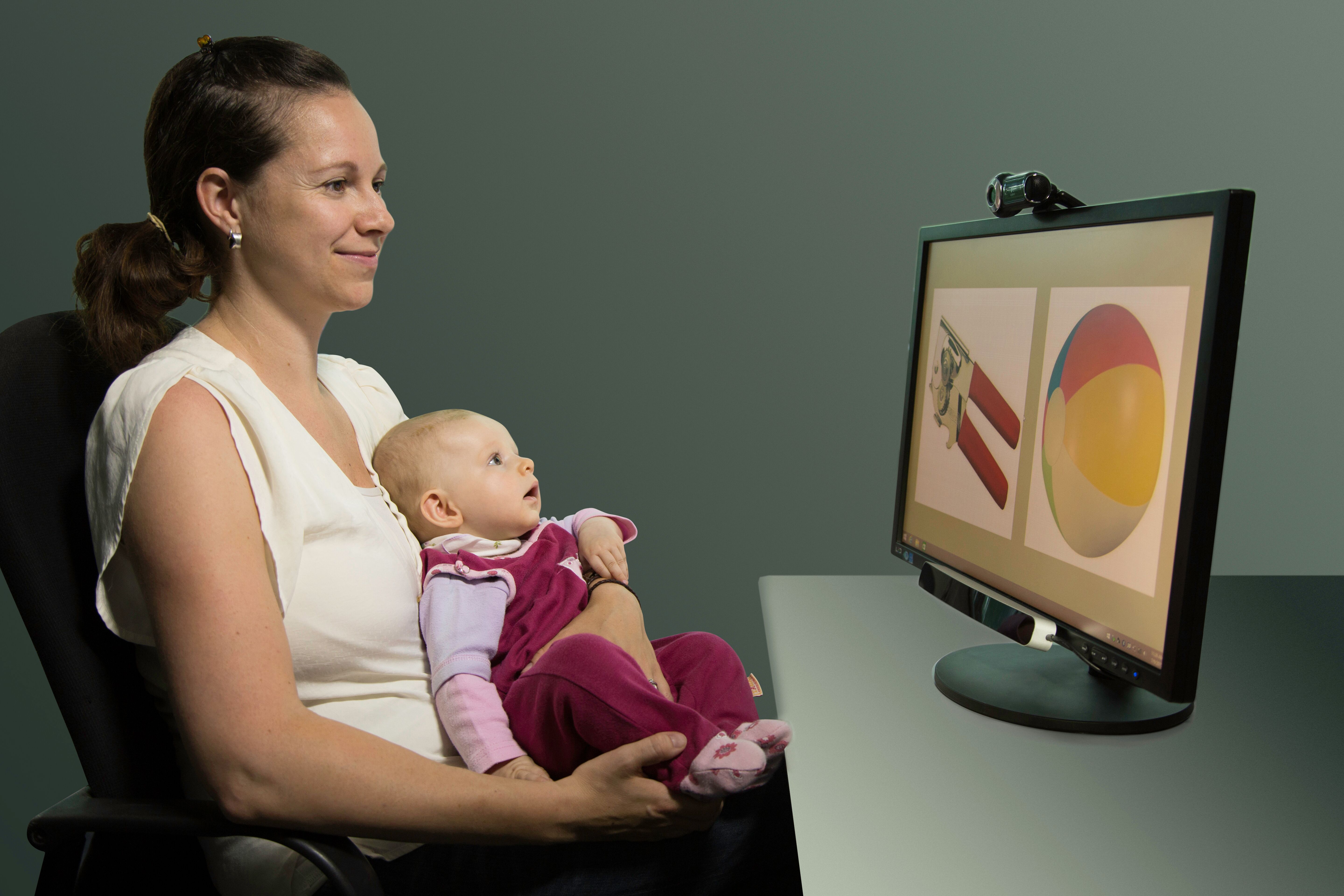
Baby Blues: Neonatal, Infant, and Toddler Research Challenges

The first five years of a child’s life are marked by considerable change—both physiological and psychological. Young children undergo incremental development in their ability to think and solve problems, their emotions, and their linguistic abilities, to name just a few developmental changes. Over time, the rapidity and extent of this development vary by individual, even among children of the same age. For these reasons, research techniques and tools must be adopted that are suitable for the participant’s age group. In this constantly evolving segment of the physiological and psychophysiological field, new approaches and technologies are being implemented with the needs of our youngest participants in mind.

Different Needs, New Approaches

A recent article published by researchers at the University of California Irvine outlined some of the challenges in conducting research within the neonatal to toddler age groups. Chief among these was the higher levels of attrition among these groups compared to older test subjects. Much of this can be linked to the general characteristics of the test group—reduced ability to sit still for long periods of time, shorter attention span, and lack of motivation to participate. While these factors may not surprise an experienced parent or childcare provider, they can throw a wrench into any study that has not taken such challenges into account.

Tools for Toddlers

Choosing the right tools and applying them appropriately in the lab setting can not only significantly improve attrition rates, but also the quality of data. Receiving a clear, uninterrupted signal when gathering data from a research participant is challenging under the best of conditions and can seem insurmountable when it involves a potentially fussy, fidgety young child or infant. Thankfully, research tools and technologies have been developed with our youngest participants in mind. These include electrodes for infants that are not only sized appropriately but also designed not to irritate sensitive skin, as well as infant-sized EEG caps that are comfortable enough to be worn for extended periods and secure to prevent excess movement and signal loss.

Combining Technique with Technology

Dyadic ResearchSome researchers have found the best approach to tackling the challenges presented by these youngest participants is a combination of age-appropriate strategies and specialized equipment. A 2020 dyadic study published in the Journal of Cognitive Neuroscience examined the Effects of Maternal Singing Style on Mother-Infant Arousal and Behavior by using skin conductance (SC) levels as a measure of arousal in both the mother and infant participants. Both participants were fitted with pre-gelled electrodes attached to BioNomadix wireless EDA transmitters, which are less cumbersome than a fully wired solution. While the mother’s electrodes were attached at the neck, the infants were attached to the foot and secured in place with paper medical tape and covered with a sock. This ensured the electrodes would be held securely in place and reduce movement that could negatively impact signal quality.

We have only scratched the surface of the tools and strategies available for conducting lab research on very young participants. For additional information, watch our webinar on Research and Best Practices for Recording from Newborns, Infants, and Toddlers.


For additional information on research tools for young participants, contact your local BIOPAC sales representative.

Holiday Happiness Part 2: Sounds, Smells, and Self-Reflection

In a previous post, we discussed the stress-reducing benefits of loving interactions with close friends and family during the holiday season. In addition to family, there are many mood-shaping habits and activities that characterize the holidays: the smell of home-cooked meals, seasonal music, and reflection on the past year, to name a few. But do these have a real impact on happiness?

In a psychophysiology study, Matsunaga, et al., tested odor effects on autobiographical memory recall. The researchers introduced several odor stimuli to participants and measured their psychological and physiological reactions. Heart rate and skin conductance were recorded throughout the experiment with a BIOPAC data acquisition system. The odor stimuli resulted in decreased heart rate, increased skin conductance level, and an increase in positive mood states.

Another article tested the effects of meditation on emotional regulation. Participants completed emotional measures before and after a meditation intervention, and had their ECG, respiration, and blood pressure recorded using a BIOPAC MP unit. The meditation correlated with greater participant emotional regulation, as suggested by lower heart rate and respiration.

In addition to meditation and smell, Harmat and Eerola have found music to also be emotionally significant. Participants listened to a musical piece, and then responded to a questionnaire about their emotional state. In addition to measuring pulse rate and facial expressions, the BIOPAC Research System and EDA Amplifier were used to record skin conductance while participants listened to the stimulus. The results found that music samples evoked several emotions, including nostalgia and happiness.

This research suggests that we can affect happiness using subtle techniques that are part of everyday living. To read more studies about psychophysiology and stress reduction, visit the BIOPAC publication page.

BIOPAC offers a variety of equipment that can be used in studies similar to the ones presented. To find more information on solutions for recording and analyzing signals such as skin conductance, ECG, heart rate, respiration, and EDA using the MP160/MP150, and other platforms, you can visit the individual application pages on the BIOPAC website. 

Electrodermal Activity (EDA)

Typically, EDA is measured as skin conductance and a small direct constant voltage (0.5 vdc) is used as excitation source across the skin electrodes.

By Alan Macy, BIOPAC Systems, Inc.

Electrodermal activity measurement is subject to electrically-related characteristics of the skin. There are two phenomena associated with this type of skin activity. One is skin potential, which is a self-generated potential intrinsic to the skin. This potential is a consequence associated with dissimilar skin layers placed in proximity coupled with the presence and movement of interstitial fluids. An evoked skin potential response is called the sympathetic skin response. This change in skin potential can be evoked by electrical, auditory or magnetic stimulation. The other phenomenon associated with skin electrical activity can be measured when a stimulation (excitation) current is injected through, or a voltage is applied across, attached skin electrodes. The current or voltage stimulation is typically at constant (DC) level, or at low frequency, because the skin impedance is high. The application of excitation current or voltage produces a corresponding voltage or current, respectively, that changes over time subject to physiological state. In these cases, the skin’s resistance, impedance, conductance or admittance is being measured, corresponding to the type of electrical stimulation used.

EDA Measurements – subject to electrical excitation type:

Skin Resistance – Direct Constant Current (not commonly used)

Skin Conductance – Direct Constant Voltage (most commonly used)

Skin Impedance – Alternating Constant Current (not commonly used)

Skin Admittance – Alternating Constant Voltage (sometimes used)

Typically, EDA is measured as skin conductance and a small direct constant voltage (0.5 vdc) is used as excitation source across the skin electrodes. The skin admittance method (alternating constant voltage excitation) may provide some advantages in measurement in that this method does not polarize the skin electrodes during EDA recording. Skin conductance is usually measured in units of “Siemens” although sometimes “mho” is used. The unit “mho” comes from the reverse spelling of “ohm”, the unit of resistance. One mho equals one Siemen.  The conductivity of the skin is small, so values are given in microsiemens (uS) or micromhos (umho).

Changes in the electrically-related characteristics of the skin is correlated to eccrine sweat gland activity. Eccrine glands are in nearly all skin locations and are found, in highest concentrations, on the palms of hands, fingertips and soles of the feet. EDA, measured as skin conductance, is a physiological signal that indicates increased sympathetic nervous system (SNS) activity. This aspect of EDA is representative of changes in the electrical conductance of the skin due to eccrine (sweat) gland activity. SNS activity increases sweat gland secretions. Eccrine glands only receive activation signals from the SNS, so increased EDA is an indicator of increased arousal.

There are two aspects to skin conductance measurements, namely phasic and tonic. Tonic value is the average skin conductance level (SCL), that is relatively consistent over time, and is related to arousal. The phasic component  of skin conductance is the change of the skin conductance, over a short time period, in reaction to a stimulus. For a skin conductance response (SCR), the skin conductance rises in a short time period and then returns to tonic levels. SCRs are characterized by four different parameters: the response peak amplitude, latency of response, rise time to the response peak, and recovery time after peak.

For more information on BIOPAC’s EDA research solutions, including real-time live raw EDA data as well as real-time filtering or calculation channels including High-pass filtered/AC Coupled EDA, visit BIOPAC’s EDA Analysis page or view BIOPAC’s full line of electrodes, amplifiers, and wearable, wireless transmitters and loggers.

Additionally, a link to a recently updated EDA SCR Analysis Guide for Psychological Experiments came be found here.

BIOPAC Systems, Inc. provides life science researchers and educators with data acquisition and analysis systems that inspire people and enable greater discovery about life.  Visit us at www.biopac.com.

error: Content is protected !!