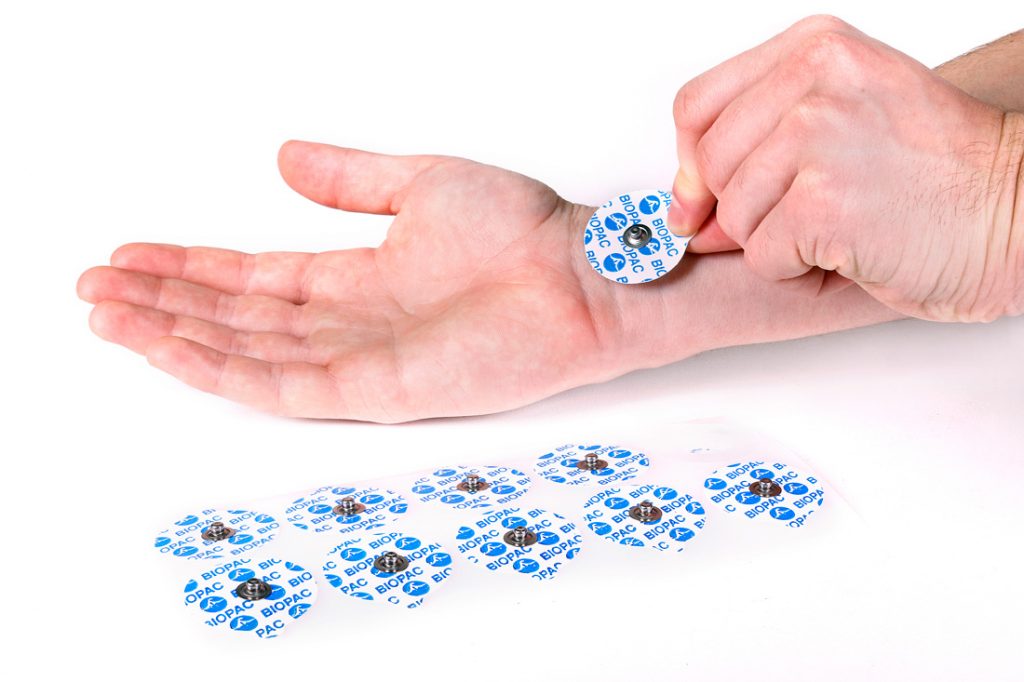
Electrode Placement and Preparation for Mobile Subject Recording

Recording the clearest possible signal can prove tricky, especially from exercising or mobile subjects. We have compiled a helpful guide on electrode placement and preparation that ensures accurate and precise data from mobile subject recording.

When recording mobile subjects, it’s important to take note of the length of lead wires and choose the shortest available option. Longer lead wires have the potential for more motion which could result in moving the electrode on the skin. If there is slack on the wire use tape and wrap to secure the wire closer to the subject’s body.

With multiple options for electrodes it’s important to consider the type of electrode would best facilitate the research. Electrodes can be designed to cover awkward shaped regions of the body or experiments extending beyond 24 hours, but for mobile subjects it’s recommended to use high stress electrodes which utilize a stronger adhesive.

Placement of the electrode is crucial. With ECG acquisition its best to put electrodes across the chest, but placement can vary depending on the research. It’s recommended to place the electrode where there’s the least amount of possible obstructive artifacts; for example, the electrode may need to be adjusted higher on the chest if subjects are using their stomach muscles. When collecting ECG placing an electrode above the bone is better than over a muscle.

The overall setup of the electrodes is very important. Using fresh gel and electrodes as well as taking time to abrade the surface of the skin allows for clearer signal acquisition. Electrodes should sit on the participant’s skin 10-15 minutes and it’s recommended to use an impedance level checker to diagnose the signal before recording.

BIOPAC’s MP160 research system with BioNomadix wireless amplifiers and logger provide the best options for data acquisition of mobile subjects. The transmitter-receiver pair and logger allow for wireless connection between the subject and MP device. BioNomadix is applicable to a wide range of physiological signals including: ECG, EEG, EMG, EOG, EGG, EDA, pulse, respiration, temperature, acceleration, goniometer, heel-toe strike, and clench force.

BIOPAC offers a variety of equipment that can be used in mobile recording studies. To find more information on solutions for recording and analyzing signals such as skin conductance, ECG, heart rate, respiration, and EMG using the MP160, and other platforms, you can visit the individual application pages on the BIOPAC website. 

History of Physiology Analysis

Thirty-plus years ago, physiological research required incredibly long lab hours and followed by slow analyzation procedures. Prior to the invention of the personal computer (Thank you Steve Jobs and Steve Wozniak!), scientists were burdened with piles of hard copy materials and painstakingly edited data sets by hand. Apple Macintosh and Microsoft Windows transformed the lab process with simple, easy-to-use personal computers. The research industry thrived with these developments and data collection hardware became faster, without the need to support multiple platforms. Physiology technology companies and researchers quickly adapted their hardware, software, and processes to align with the advances in computer science, leading us to the smaller and faster machinery of today.

In the 1980s, hardware products utilized serial ports and ISA serial cards. These serial ports allowed the data exchange to move faster, but researchers still worked with complex hardware set-ups. Responsively, the USB development of 1994 expedited data exchange processes and accelerated lab projects because scientists no longer needed to deal with the complexities of serial ports.

Ethernet technology soon followed and continues to support data exchange and internet service for labs because of its dependability. Rapid technological advancements used among professionals led industry experts to create wearable and sometimes wireless technology for physiology research. Industrial scientific medical radio waves also improved communication so that researchers and developers could work quickly without a paper trail.

Today, the scientific community embraces technological advancements beyond what would have been their wildest dreams in the mid-1980’s before the release of the personal computer. Smart devices, artificial intelligence, and rapid data exchange methods produced advancements that changed our personal and work lives.

BIOPAC’s technology evolved along-side the computing industry. Leading the way in data collection and analysis hardware and software, BIOPAC developed research improvements by producing more efficient, faster and powerful products used in labs across the world, including AcqKnowledge software and BioNomadix wearable devices. Physiology technology improves the classroom and workroom environments of any researcher trying to understand human conditions whether for profit or social justice because subjects can wear devices outside the lab, process information effectively, and synchronize various data sets at once with AcqKnowledge.

BIOPAC equipment can be used in studies for almost any field. To find more information on BIOPAC’s research solutions, visit the individual application pages on the BIOPAC website.

error: Content is protected !!