History of Physiology Analysis

Thirty-plus years ago, physiological research required incredibly long lab hours and followed by slow analyzation procedures. Prior to the invention of the personal computer (Thank you Steve Jobs and Steve Wozniak!), scientists were burdened with piles of hard copy materials and painstakingly edited data sets by hand. Apple Macintosh and Microsoft Windows transformed the lab process with simple, easy-to-use personal computers. The research industry thrived with these developments and data collection hardware became faster, without the need to support multiple platforms. Physiology technology companies and researchers quickly adapted their hardware, software, and processes to align with the advances in computer science, leading us to the smaller and faster machinery of today.

In the 1980s, hardware products utilized serial ports and ISA serial cards. These serial ports allowed the data exchange to move faster, but researchers still worked with complex hardware set-ups. Responsively, the USB development of 1994 expedited data exchange processes and accelerated lab projects because scientists no longer needed to deal with the complexities of serial ports.

Ethernet technology soon followed and continues to support data exchange and internet service for labs because of its dependability. Rapid technological advancements used among professionals led industry experts to create wearable and sometimes wireless technology for physiology research. Industrial scientific medical radio waves also improved communication so that researchers and developers could work quickly without a paper trail.

Today, the scientific community embraces technological advancements beyond what would have been their wildest dreams in the mid-1980’s before the release of the personal computer. Smart devices, artificial intelligence, and rapid data exchange methods produced advancements that changed our personal and work lives.

BIOPAC’s technology evolved along-side the computing industry. Leading the way in data collection and analysis hardware and software, BIOPAC developed research improvements by producing more efficient, faster and powerful products used in labs across the world, including AcqKnowledge software and BioNomadix wearable devices. Physiology technology improves the classroom and workroom environments of any researcher trying to understand human conditions whether for profit or social justice because subjects can wear devices outside the lab, process information effectively, and synchronize various data sets at once with AcqKnowledge.

BIOPAC equipment can be used in studies for almost any field. To find more information on BIOPAC’s research solutions, visit the individual application pages on the BIOPAC website.

Creating new Models to Share and Analyze Physiological Data

Advancing technology allows researchers the ability to utilize physiological data in different forms. This includes utilizing mathematic models to answer research questions, making data openly accessible to those with similar research questions, and identify alternative approaches to physiological measurements. Studies recently published in the field of biomedical engineering provide examples of these different quantitative approaches.

Researchers Chalacheva et al. (2017) have identified vaso-occlusive crisis (VOC) as a complication unique to sickle cell disease, they wanted to identify if a lab induced VOC reaction was telling about the disease itself. Using heat pulses to evoke a VOC reaction, participants’ reaction were acquired through BIOPAC’s MP research system. Researchers were then able to create a math based model for the use in clinics, which could analyze the severity of sickle cell through measuring evoked VOC reactions.

Chest surface motion can provide insight in how the cardiovascular and respiratory systems act together, researchers Shafiq and Veluvolu (2107) attempted to model chest motion further. ECG, chest motion, and air flow were gathered through BIOPAC’s MP36R research system as participants were given a multitude of breathing tasks. The data acquired was used to create an algorithm to map out chest movements allowing for more precision with radiation therapy in treating lung cancer, which is often challenging and potentially dangerous. The dataset was made openly available, encouraging its use in chest motion modeling as well as other cardiovascular based research.

Blood pressure is an important indicator of various cardiovascular diseases, due to hypersensitive patient’s inability to use pressure cuffs; Shin and Min (2017) identified a need for an alternative form of BP acquisition. BIOPAC’s MP research system acquired the less invasive PPG measurements, the hypothesized as an alternative to blood pressure. The study identified PPG alone can’t be used to measure blood pressure, but allowed for the development of a pressure index for further research in alternative forms of blood pressure monitoring.

The above studies recognize the importance in analyzing trends and sharing data of physiological reactions. If interested in more articles regarding developments in biomedical engineering, visit BIOPACs research publication page. BIOPAC offers a variety of equipment for any research question, find more information on BME biomedical engineering solutions through visiting our applications page.

Fundamentals of EEG Recording

In 1929, a German physician named Hans Berger discovered that electrodes placed on the scalp could detect various patterns of electrical activity. After verifying that the recordings were indeed recording from the brain, and were not artifacts of muscle or scalp, scientists began to study these “brain waves.” Today, EEG is still a medically useful recording for brain function. In medical and basic research, the correlation of particular brain waves with sleep phases, emotional states, psychological profiles, and types of mental activities is ongoing.

EEG records the electrical activity of the brain. Surface EEG electrodes provide a noninvasive way to measure brain function and regional brain activity. The EEG signal is made up of different frequency components and the amplitude of the signal varies in the different frequency bands: alpha, beta, delta, theta, gamma.

Rhythm Typical Frequencies (Hz)
alpha
beta
delta
theta
gamma
8-13
13-30
1-5
4-8
>32

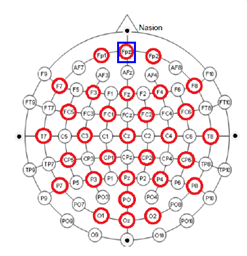
EEG can be recorded by placing electrodes on the scalp of the subject. The placement of the electrodes is important to ensure that you are recording data from the correct location when comparing and reporting results.The electrodes are placed on specific locations on the head. Each electrode location is given an alphanumeric name. Alpha is related to actual zone for electrode placement: F-Frontal, C-Central, T-Temporal, P-Parietal, O-Occipital zones. Numeric is based on the two hemispheres, odd numbers representing left side and even numbers representing right side.

EEG Electrode PlacementThese locations are over certain areas of the brain that allow us to identify different types of activity:

  • F7 near centers for rational activities
  • Fz near intentional and motivational centers
  • F8 close to sources of emotional impulses
  • C3,C4,Cz deal with sensory and motor functions
  • T3 and T4 emotional process
  • T5 and T6 certain memory functions
  • O1 and O2 for primary visual areas

An EEG cap can also be used to ensure proper electrode placement. The size of the EEG cap is critical in EEG recording. Having the correct cap size means that you can ensure that you are recording the correct brain location, otherwise you may think you’re recording F5 when you’re really recording F9.

Recording EEG is a bipolar recording (looking at difference between two electrodes). Electrodes are typically referenced to a physical electrode or site –

  • vertex (Cz)
  • linked-ears
  • linked-mastoids
  • ipsilateral-ear
  • contralateral-ear
  • C7 reference
  • bipolar references

Recording can also be done using reference-free techniques when using 20 or more channels. The system will usually automatically take an average of all the electrodes rather than a physical location. The different averages include:

  • Weighted average reference
  • Common average reference

Once you have your EEG data, utilize AcqKnowledge software to run a number of fully automated EEG analysis functions. A range of fully automated routines provide quick, easy and reproducible results and include approximate entropy, delta power analysis, derive alpha RMS, derive EEG frequency bands, and EEG frequency analysis. The EEG frequency analysis provides a fully automated, epoch driven, analysis of the EEG signal. The system uses power spectral density to report Mean Power, Median Frequency, Mean Frequency, Spectral Edge, Peak Frequency values for each epoch.

For more information on BIOPAC’s wide range of tools for recording, displaying, and analyzing EEG measurements from human and animal subjects, visit BIOPAC’s electroencephalography pages and view BIOPAC’s full line of electrodes, amplifiers, and wearable, wireless transmitters and loggers.

BIOPAC Systems, Inc. provides life science researchers and educators with data acquisition and analysis systems that inspire people and enable greater discovery about life. Visit us at www.biopac.com.

Are Virtual Reality Exercising Games Effective?

In an age of increased obesity and obsession with exercise, software companies have created exercise video games that engage users both mentally and physically. Mixed reviews about the effectiveness of such exergames stem from several components: the perceived task demands during a game, the reward given by the game, and the user’s Exercise Self-Efficacy (ESE, individuals’ confidence in performing exercise tasks). Cornick & Blascovich (2017) explore these components in their study to find exercise and physiological reactions and, in turn, effective motivations in exergames.

The experiment included 89 female undergraduate students who were first evaluated based on the ESE scale. Next, they were randomly assigned to either a high task demand condition in which their avatar weight remained constant, or a low task demand condition in which their avatar lost weight. Participants exercised on a stationary bike while absorbed in a virtual environment. Both groups were informed that their avatar would lose weight if they biked fast enough, when in reality, only half of their avatars could.

Participants’ physiological responses including heart rate, stroke volume, cardiac output, pre-ejection period, and blood pressure were all measured concurrently, continuously, and noninvasively with a BIOPAC MP System while biking. Cardiac performance was measured with an Impedance Cardiograph (ICG) and NIBP100D. AcqKnowledge software was used to distinguish participant challenge and threat states. One week following the study, participants reported how much they exercised in the last week.

The surprising results revealed that participants with high ESE had a high threat response and performed a modest amount of cardiac work, regardless of task demands. Participants with low ESE were extremely influenced by exergame task demands. When presented with a slimming avatar, they had the highest levels of a threat response, and the highest cardiac workload. When presented with a constant avatar, they had a challenge response and low levels of cardiac workload. As a result, it is conclusive that female self-perception has a significant influence on physiological response when body dissatisfaction is high. Exergames must include options that tailor to each individual based on their ESE as well as their preference of performance tracking during exercise.

Memory and Perception

The cognitive processing of memory affects our individual perception therefore it is important to understand what factors influence an individual’s processing. We have compiled a list of studies that look at how recall can influence individual’s message perception and work to help understand how small cases of memory load or the act of remembering can carry greater implications.

Cognitive Psychology Experiment

Cognitive development is crucial at the preliminary stages of infancy in children. Researchers Brito et al. (2016) examined associations between infants’ EEG power and cognitive abilities such as language and memory and situational factors such as SES. BIOPAC’s EEG100C and electrocap were used to record EEG while the infants were asleep. Overall EEG was then compared to memory and language skills, which were assessed through various tasks while the infant was awake. The findings identified that there are no associations between SES and EEG power, nor was EEG power related to language and memory ability.

EEG and Movie Trailers

University of Pennsylvania researchers studied EEG monitoring to understand how memory recall can influence the effectiveness of an advertiser’s messages. Utilizing a mixed methodology approach, measuring EEG brain activity data and physiological reactance, researchers Barnett and Cerf (2017) created a cross brain correlation (CBC) of 58 participants being exposed to the same 13 movie trailers. BIOPAC’s BioNomadix wireless EEG amplifier recorded EEG data in a commercial movie theater setting. Physiological monitoring solutions included BIOPAC’s respiration belt transducer, and a wireless EDA amplifier. The study’s results suggested that a trailer’s level of memorability could predict the movie’s overall success.

Intrusive Memory Study

One unfortunate side effect of memory is its intrusiveness in perceiving messages. Researchers from Oklahoma State University attempted to identify how worry (an effect of memory load) can influence “attention allocation” and an individual’s ability to process information. In the study conducted by White and Grant, it was hypothesized that, “working memory load will decrease attention allocation during processing of emotional images (White and Grant, 2017).” BIOPAC solutions were utilized in the methodology using an MP research system paired with an EEG100C amplifier as well as AcqKnowledge software. The study compared two groups of participants who were shown a series of similar photos. One group was presented with memory based verbal or visual tasks at the beginning of the experiment. Among other more specified findings, the results indicated that individuals with lower levels of worrying had reduced attention when required to remember visual and verbal memory tasks.

Understanding how cognitive processes and memory relate to one another provides researchers with the opportunity of gaining greater insight into message retention. The foundations of language and memory that we development as infants play key roles in our message retention. These combined with individual attention and outside stimuli show that our memory can inhibit message reception.

Tips for implanting rodent pups with the Epoch wireless recording system

Implanting pups can be tricky, yet their value as neonatal models of human disease is key.

Tips for implanting rodent pups with the Epoch wireless recording system

The Epoch system enables recording 2 or 4 channels of EEG from neonatal rodents as young as postnatal day 10 (P10) in mice and P6 in rats using the 2-week transmitter. Implanting pups can be tricky—their skulls are very thin and the small size of the animals is difficult to work with. Yet, their value as neonatal models of human disease is key to developing new therapies or understanding neural dysfunction at such an early age.

Our experience has led to the following tips for maximizing the success of implanted pups:

  1. Allow pups time to recover. Although recordings can commence immediately, we recommend waiting 24 hours before commencing recordings to allow a fuller recovery.
  1. Limit recording time. Recording from rodent pups should be limited to about 2 h at a time, preferably in a temperature- and humidity-controlled incubator.
  1. Keep pre-weened pups in their dam’s presence as often as possible. Pups rely on the dam for complete care.
  1. Cull the litter to 4-6 pups. The dam may have issues with pups that are overly cold, not feeding often enough, or simply due to the presence of the transmitter.
  1. Implant all pups. It may be helpful to implant all pups in a litter either with Epoch transmitters or sham transmitters (sham transmitters are available, contact us).
  1. Use chew toys to prevent damage from the dam. Chew toys, such as nylabones, may help prevent the dam from chewing on the transmitters.
  1. Mind the state of the dam. Ultimately, the health and disposition of the dam may affect how she tolerates pups implanted with the Epoch transmitters.

Epoch, the smallest wireless EEG transmitter system available, is provided by BIOPAC to make quality EEG recordings from an early age possible. The Epoch transmitter is simply implanted to the skull of the animal with medical cyanoacrylate, requiring no bone screws. Surgery is quick and simple, requiring a small incision on the scalp, removal of the periosteum with 1% hydrogen peroxide, drilling small holes for the electrodes using a burr-type drill, implanting the transmitter, and re-absorbable sutures.

For more information on BIOPAC’s wide range of tools for recording, displaying, and analyzing EEG signals from human and animal subjects, including automated EEG analysis, seizure detection, evoked responses and many others, visit BIOPAC’s EEG Analysis page or view BIOPAC’s full line of electrodes, amplifiers, and wearable, wireless transmitters and loggers.

BIOPAC Systems, Inc. provides life science researchers and educators with data acquisition and analysis systems that inspire people and enable greater discovery about life. Visit us at www.biopac.com.

Stressing over the effects of stress

Several studies show chronic stress is typically detrimental to health, while acute stress may be linked to positive effects in addition to the negative counterparts

With April comes National Stress Awareness Month, and it bears noting that different types of stress have varying effects. Where chronic stress is typically detrimental to health, acute stress may be linked to positive effects in addition to the negative counterparts. But is this trade-off worth it?

In a biological psychology experiment testing the effect of oxytocin on acute social stress, researchers found different results between men and women. Subjects underwent several stress tasks while their electrocardiography and impedance cardiography were recorded with a BIOPAC MP Research System and amplifiers. The researchers found that after being given oxytocin during the stressful event, men had less negative affect and women had greater math performance (compared to the control group).

A neurobiology study examined the effect stress had on an extinction memory process when a competing association was paired with a previously aversive cue. To test this, participants were presented with two images, one that was paired with a shock from a BIOPAC bar electrode, and one that was not. Extinction memory training immediately followed this stimulus, with extinction retrieval testing following a day later. Data gathered by a BIOPAC data acquisition system suggested significantly lower retrieval in the group that experienced the acute stress stimulus.

Another biopsychology experiment measured the effect of acute stress on pro-inflammatory cytokine levels in the blood. BIOPAC equipment was used to measure ECG while participants were given the Trier Social Stress Test. After reviewing the data and blood samples, the researchers determined that levels of the cytokine cell, interleukin-1β, increased significantly immediately after the stress test.

The physiological and psychological impacts of stress are clearly multifaceted with many potential results. In some situations, a heightened positive affect or greater analytical thinking may be beneficial. But is this boost in mental performance worth the increase of inflammatory cells and lower memory retention? As with many aspects of life, moderation is the safest answer, ensuring the negative effects do not become chronic problems.

For more information on BIOPAC’s wide range of tools for recording, displaying, and analyzing ECG measurements from human and animal subjects including respiration, heart rate variability, and RSA, visit BIOPAC’s electrocardiography pages and view BIOPAC’s full line of electrodes, amplifiers, and wearable, wireless transmitters and loggers.

BIOPAC Systems, Inc. provides life science researchers and educators with data acquisition and analysis systems that inspire people and enable greater discovery about life. Visit us at www.biopac.com.

The Trouble with Fatigue

Fatigue is a troublemaker–it can have serious impacts on data quality, even when using gold standards of measurement.

Fatigue is a known troublemaker in athletics, but can also have negative effects in physiology research. Fatigue can become a confounding variable, giving researchers data that may be less accurate or reliable.

Men and women may respond to fatigue differently, which can make obtaining good data especially difficult. In one study on fatigue by Stern et al. (2012), the researchers attempted to monitor fatigue and show different effects between men and women. This study attempted to follow a central nervous system component, as well as the peripheral nervous system. Using the BIOPAC MP160 system with AcqKnowledge software to record and analyze EMG, researchers were able to continually monitor muscle and neuron activation during the exercise tests.

The results of the study found that females had a higher rate of reduced central neural drive of the quadriceps, coupled with knee extension torque preservation. These factors, when paired together, can create a higher percentage for the possibility of knee injury for women.

With coffee being such a staple in the home (and in the lab!), researchers Smirmaul et, al (2017) wanted to see if coffee had any effect on fatigue, duration of exercise, and the perception of effort. This study used seven adult male cyclists in moderate hypoxic states to obtain their results. The experiment used a double-blind procedure, with some participants receiving no coffee. The researchers wanted to see if the coffee participant group took a longer time to reach fatigue. EMG was obtained by using BIOPAC MP160 with EMG amplifiers. The results showed that coffee has no effect on fatigue, but coffee did improve the time it took until the athletes reached exhaustion in high endurance tasks. The researchers believe that coffee lowers the perceived effort of the athlete, leading them to think they can go further.

Fatigue can also have impacts on data, even when using gold standards of measurement. A separate study done on fatigue by Neyroud et al. (2016), attempted to show that muscle fatigue has an effect on the validity of the ITT (Interpolated Twitch Technique). The ITT is used to evaluate the capacity of the central nervous system in activating skeletal muscles. This study used BIOPAC’z MP research system with EMG amplifiers to monitor muscle and neuron activation. Electrical stimulus was given to both samples to create fatigue, and a separate stimulus was given to mimic the ITT. This study found that peripheral fatigue factors do have an effect on the outcome of the ITT.

BIOPAC offers a variety of equipment that can be used in studies similar to the ones presented. To find more information on solutions for recording and analyzing signals such as EEG, EMG, respiration, skin conductance using the MP160/MP150, MP36, and other platforms, you can visit the individual application pages on the BIOPAC website. If you are interested in reading other related studies, visit the publications page on the BIOPAC website.

Holiday Happiness Part 2: Sounds, Smells, and Self-Reflection

In a previous post, we discussed the stress-reducing benefits of loving interactions with close friends and family during the holiday season. In addition to family, there are many mood-shaping habits and activities that characterize the holidays: the smell of home-cooked meals, seasonal music, and reflection on the past year, to name a few. But do these have a real impact on happiness?

In a psychophysiology study, Matsunaga, et al., tested odor effects on autobiographical memory recall. The researchers introduced several odor stimuli to participants and measured their psychological and physiological reactions. Heart rate and skin conductance were recorded throughout the experiment with a BIOPAC data acquisition system. The odor stimuli resulted in decreased heart rate, increased skin conductance level, and an increase in positive mood states.

Another article tested the effects of meditation on emotional regulation. Participants completed emotional measures before and after a meditation intervention, and had their ECG, respiration, and blood pressure recorded using a BIOPAC MP unit. The meditation correlated with greater participant emotional regulation, as suggested by lower heart rate and respiration.

In addition to meditation and smell, Harmat and Eerola have found music to also be emotionally significant. Participants listened to a musical piece, and then responded to a questionnaire about their emotional state. In addition to measuring pulse rate and facial expressions, the BIOPAC Research System and EDA Amplifier were used to record skin conductance while participants listened to the stimulus. The results found that music samples evoked several emotions, including nostalgia and happiness.

This research suggests that we can affect happiness using subtle techniques that are part of everyday living. To read more studies about psychophysiology and stress reduction, visit the BIOPAC publication page.

BIOPAC offers a variety of equipment that can be used in studies similar to the ones presented. To find more information on solutions for recording and analyzing signals such as skin conductance, ECG, heart rate, respiration, and EDA using the MP160/MP150, and other platforms, you can visit the individual application pages on the BIOPAC website. 
Holiday Happiness: Gratitude or Gifts?

Studies investigated the anxiety of gift-giving, the effects of social support in stressful situations, and what impact meditation has on heart rate, ECG, and blood pressure.

December has arrived, and for many the holidays bring a rush to check items off of a long shopping list for parents, siblings, friends, in-laws, and many more. Often we struggle to find that “perfect” gift, but are the physical goods we exchange the true source of the warmth and happiness that characterizes the season?

An article by Nomura investigated anxiety induced by gift-giving. To test this, EDA data was recorded with a BIOPAC data acquisition system and STP100 while participants responded to stimuli. The participants visualized a specific relative while being presented with potential gift options, and were asked how likely they were to purchase the potential gift for that relative. The data found that people who self-reported thinking of in-laws were the most stressed, while those who reported thinking of children or same-gender friends were least stressed.

A psychosomatic study by Inagaki and Eisenberger found that mental and physical well-being benefit from forms of social support. They tested this by administering mild shocks with the BIOPAC STMISOLA to male patients who held the hand of a female partner lying in an fMRI. The results suggest that this support (hand-holding) provided possible stress-reduction for both the male and female participants.

Another article on nonverbal communication and well being by Shaltout, et al. tested the effects of meditation and the subsequent ECG, blood pressure, and heart rate effects. The BIOPAC ambulatory BioHarness and NIBP Blood Pressure System gathered data while participants underwent several mediation episodes, during which they were instructed to focus on loving kindness towards a subject. The results found that participants had decreased heart rate.

Research suggests direct, loving interactions with those who are close to us have many stress-reducing benefits. So when you are shopping for gifts, remember that spending time is more important than spending money. To read more studies about love and stress reduction, visit the BIOPAC publication page.

BIOPAC offers a variety of equipment that can be used in studies similar to the ones presented. To find more information on solutions for recording and analyzing signals such as EEG, EMG, respiration, and EDA using the MP160/MP150, MP36, and other platforms, you can visit the individual application pages on the BIOPAC website. 

BIOPAC Systems, Inc. provides life science researchers and educators with data acquisition and analysis systems that inspire people and enable greater discovery about life. Visit us at www.biopac.com.

error: Content is protected !!