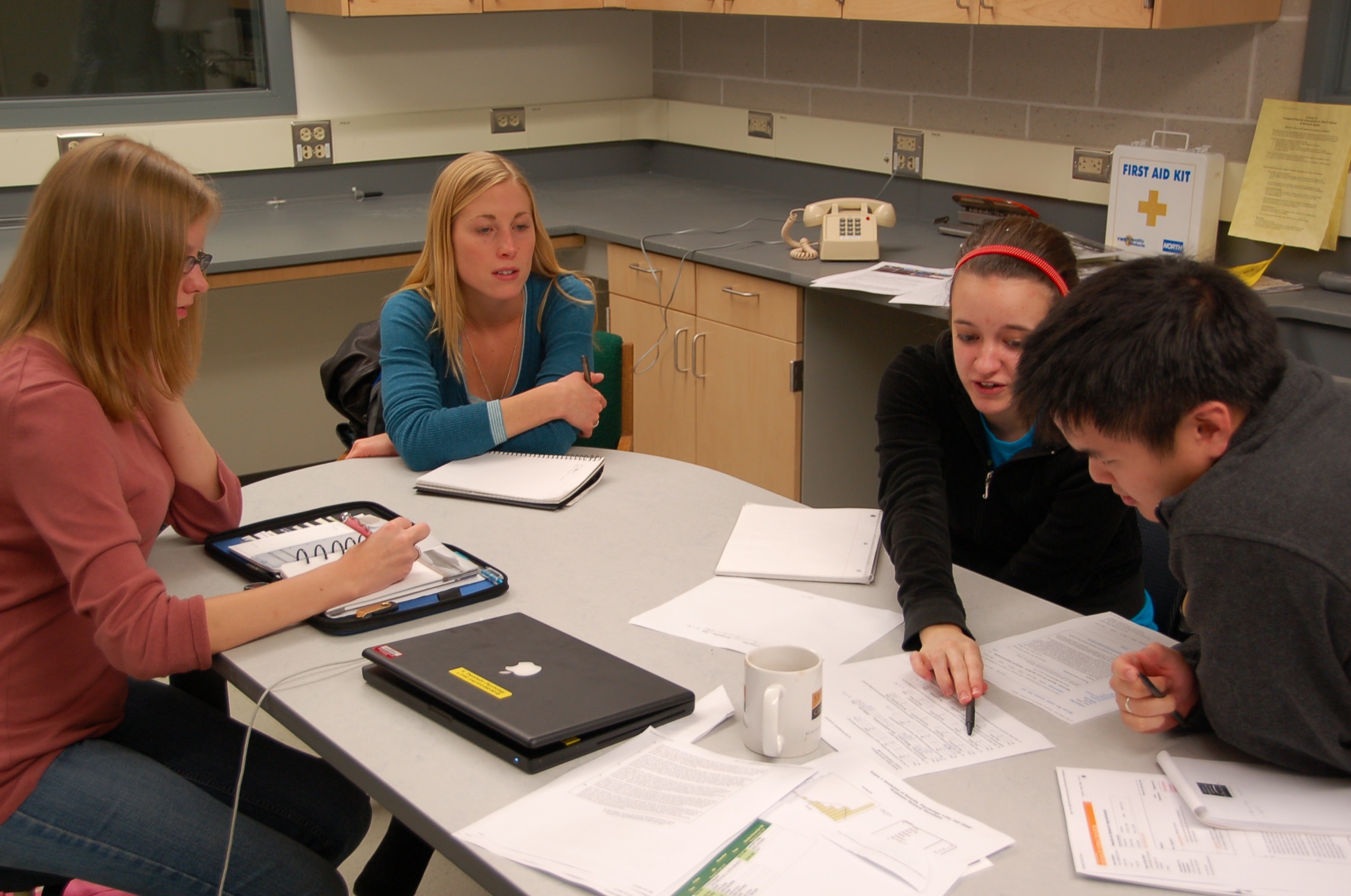
Thinking As Scientists Think

By Howard Iver Thorsheim, Ph.D., St. Olaf College. Information literacy skills projects help students discover that they know that they know how to find information, which increases their sense of competency, and is self-reinforcing.

(Photo © 2016 Knowledge Growers, Inc.)

By Howard Iver Thorsheim, Ph.D., St. Olaf College

I have titled this blog “Thinking As Scientists Think.” A more accurate—but longer—description might be “Helping Students Learn Skills to Think As Scientists Think—Information Literacy Skills.” I have found it effective to help students learn two levels of skill development that will help them think as scientists think: (a) information literacy skills to learn about the skills, which is the focus of this blog, and (b) empirical research skills to do the skills they have learned about (discussed in this post, building on Biopac Student Lab lessons).

I partner with a librarian colleague to develop and provide an initial 45-minute information literacy skills session on how to use available databases to locate information. I provide a selected list of research skills to guide their search. Teams decide exactly what they read online about each listed skill, so information each team locates may be unique, though the skills searched are the same. They discover that they know that they know how to find information, which increases their sense of competency, and is self-reinforcing.

You can select your own list of research skills you wish students to learn about, to fit your own teaching/learning goals and schedule. The following are some examples from my skills list for introducing psychophysiology in courses:

  1. strategy for using information literacy skills;
  2. using a consultant (in this case it is me, their teacher);
  3. forming research questions;
  4. psychophysiology methods;
  5. operationalization of variables;
  6. psychophysiological measurement;
  7. adhering to research ethics;
  8. statistical analysis in psychophysiology (selecting methods appropriate from their course background ranging from descriptive to more sophisticated statistics);
  9. writing following the format of the Publication Manual of the American Psychological Association, and
  10. oral presentation skills (e.g., tips for presenting their summaries that will help them be excellent peer-mentors).

The genuine research skills students learn support your course goals and engage students in science, contribute to national STEM goals, and add to a student’s thinking toolkit. Students can annotate their team-based information-literacy searches and can include that in a cumulative personal skill inventory, useful for skill-based résumés for assistantships, jobs, and graduate applications.

Here are two helpful resources on the usefulness of helping students develop genuine research-oriented skills and begin using them:

Jenkins, A. & Healey, M. (2010). Undergraduate research and international initiatives to link teaching and research. Council on Undergraduate Research Quarterly, 30(3), 36-42.

Mervis, J. (2016). Genuine research keeps students in science. Science, 352(6291), 1266.
DOI: 10.1126/science.352.6291.1266


Learn more about BIOPAC’s education solutions, including complete teaching systems for psychophysiology and the life sciences. BIOPAC also provides a wide range of research systems for recording, displaying, classifying, and analyzing psychophysiological measurements.

BIOPAC Systems, Inc. provides life science researchers and educators with data acquisition and analysis systems that inspire people and enable greater discovery about life. Visit us at www.biopac.com.

Professor Thorsheim is a licensed Psychologist, educator, and author. He has published or presented over 125 papers, journal articles, books, book chapters or monographs, and received a patent in 1985 as a co-inventor for an educational book design with interactive elements. His work has been funded by marquee foundations across the globe. His most recent work is Doing Psychophysiology: Getting Started, available from Knowledge Growers, Inc., available as an iBook download in 51 countries.

How to Promote Cooperative Thinking

By Howard Iver Thorsheim, Ph.D., St. Olaf College. How to promote cooperative thinking of team members doing psychophysiology, draw from their richly diverse interests and ideas, and in the process teach a “soft” skill that could transfer to later life.

(Photo © 2016 Knowledge Growers, Inc.)

By Howard Iver Thorsheim, Ph.D., St. Olaf College

Howard Iver Thorsheim is Professor of Psychology and Neuroscience at St. Olaf College, Northfield, Minnesota, USA. In these blogs he offers his first-person insights into effective teaching techniques gleaned from a combination of scholarly research and over 40 years in the classroom.

The Challenge:

The challenge was how to promote cooperative thinking of team members doing psychophysiology, drawing from their richly diverse interests and ideas, and in the process to learn a “soft” skill that could transfer to later life.

The Solution:

I adapted a tried-and-true group process to help team members doing psychophysiology research identify diverse ideas and think about their group project in a cooperative way. (The technique can be scaled up to engage many teams simultaneously). The technique is called the Nominal Group Technique, first developed by DelBecq and Van de Ven (1975).* The reason for the word nominal is evident in Step 1.

Step 1. Each student in a team was given a stack of 25 or so Post-it® notes. Because each student is working alone at this point, they are a group in name only (i.e., nominally a group). Their homework assignment was to think independently about ideas and interests that came to mind for them, and jot down a few words identifying their idea or interest on each of the Post-it notes. Interaction comes in step 2.

Step 2. The next class, the team members gathered together near a whiteboard. In a round-robin interactive fashion, one at a time, the students placed their Post-it notes on the board: One person started by placing the top Post-it from their stack on the board; the second person placing their first Post-it note close or further away from the first person’s Post-it note, depending upon their sense of closeness of the ideas. So it goes with the other students, with the round robin continuing until all Post-it notes are placed on the wall. Step 3 is the convergence!

Step 3. Again in a round-robin fashion, students take turns with a non-permanent marker drawing dashed lines around clusters they observe, and jotting down their idea for a name for each cluster. The result from the large group of individual ideas or interests becomes a smaller cluster of related ideas. The result is more coherence of ideas, engagement, social cohesion, and team focus. It works every time in any team or group!

See how the Center for Disease Control adapts the technique in this Nominal Group Technique (NGT) Evaluation Brief.

*Delbecq, A. L., Van de Ven, A. H., & Gustafson, D. H. (1975). Group techniques for program planners: a guide to nominal group and Delphi processes. Glenville, Illinois: Scott Foresman.


Learn more about BIOPAC’s education solutions, including complete teaching systems for psychophysiology and the life sciences. BIOPAC also provides a wide range of research systems for recording, displaying, classifying, and analyzing psychophysiological measurements.

BIOPAC Systems, Inc. provides life science researchers and educators with data acquisition and analysis systems that inspire people and enable greater discovery about life. Visit us at www.biopac.com.

Professor Thorsheim is a licensed Psychologist, educator, and author. He has published or presented over 125 papers, journal articles, books, book chapters or monographs, and received a patent in 1985 as a co-inventor for an educational book design with interactive elements. His work has been funded by marquee foundations across the globe. His most recent work is Doing Psychophysiology: Getting Started, available from Knowledge Growers, Inc., available as an iBook download in 51 countries.

Start the First Class with EDA and Emotional Responses!

By Howard Iver Thorsheim, Ph.D., St. Olaf College. I wanted to start the first day of my class with an activity that would engage students’ curiosity and enthusiasm, to set the stage for introducing the course and going over the syllabus!

By Howard Iver Thorsheim, Ph.D., St. Olaf College

Howard Iver Thorsheim is Professor of Psychology and Neuroscience at St. Olaf College, Northfield, Minnesota, USA. In these blogs he offers his first-person insights into effective teaching techniques gleaned from a combination of scholarly research and over 40 years in the classroom.

I find Electrodermal Activity (EDA) to be a great way to demonstrate psychophysiology measurement at the beginning of a course: students easily understand it. It takes little time to set up and record because it only involves two sensors on the finger tip pads. It works every time as a “window” to emotions with clear responses to a variety of stimuli (e.g., visual, auditory, gustatory, olfactory).

I show students a picture of a rock climber climbing a cliff, then ask them to jot down some notes of what they might feel when climbing like the woman pictured, and then buzz with a person sitting next to them about what they wrote. I ask for a show of hands of who has mentioned the bag hanging from the climber’s belt. Depending on the amount of time I choose to devote to the activity, I lead the entire class through a number of probing questions; for example:

“Who knows what the bag is for?” (Chalk for fingers.)

“Why does the climber use chalk?”  (Reduce slipperiness from sweat.)

“Why do fingers get slippery?” (Emotion.)

“What other people encounter emotion daily?”

I then set the stage for EDA: changes in skin conductivity are due to the amount of sweat in sweat glands of the skin, which are produced by the sympathetic branch of the autonomic nervous system responding to emotion.

I explain to the class that I will be the first volunteer, and guarantee that no shock is involved using BIOPAC equipment. I connect electrodes on the volar pads of my index and middle fingers, and take a deep breath, which will generate EDA. Then I tell the class I will think of emotion-producing situations, and ask them if they can see any EDA detected by the equipment. There will be a few good chuckles because in anticipation of doing so, my response will already appear. Two of several easy classroom measurements of EDA include latency (about 1 to 3 seconds between a stimulus and beginning of the electrodermal response), and peak amplitude (the maximum size of the response). My eBook Doing Psychophysiology–Getting Started on the Apple iBooks Store has a graphic narrative and a one-minute video explanations about EDA, as well as other psychophysiology measures you can show your students. The Biopac Student Lab system also includes two lessons in which students can engage in interactive learning activities while measuring EDA; a lesson on the principles of biofeedback and one on the standard physiological measures of a polygraph.

An excellent summary of Electrodermal Activity is provided in the following chapter:

Dawson, M. E., Schell, A. M. & Fillion, D. L. (2007). The electrodermal system. In J. T. Cacioppo, L. G. Tassinary, & G. G. Berntson (Eds.). Handbook of psychophysiology (3rd ed. pp. 159-181). New York: Cambridge University Press.

Learn more about BIOPAC’s education solutions, including complete teaching systems for psychophysiology and the life sciences. BIOPAC also provides a wide range of research systems for recording, displaying, classifying, and analyzing psychophysiological measurements.

BIOPAC Systems, Inc. provides life science researchers and educators with data acquisition and analysis systems that inspire people and enable greater discovery about life. Visit us at www.biopac.com.

Professor Thorsheim is a licensed Psychologist, educator, and author. He has published or presented over 125 papers, journal articles, books, book chapters or monographs, and received a patent in 1985 as a co-inventor for an educational book design with interactive elements. His work has been funded by marquee foundations across the globe. His most recent work is Doing Psychophysiology: Getting Started, available from Knowledge Growers, Inc., available as an iBook download in 51 countries.

 

Forming Cooperative Learning Groups: The Solution

By Howard Iver Thorsheim, Ph.D., St. Olaf College. Students think psychophysiology is cool…. It generates all kinds of buzz, interest, excitement, questions–even from other faculty and administrators–and psychophysiology appeals to many students in related disciplines,

(Photo © 2016 Knowledge Growers, Inc.)

By Howard Iver Thorsheim, Ph.D., St. Olaf College

Howard Iver Thorsheim is Professor of Psychology and Neuroscience at St. Olaf College, Northfield, Minnesota, USA. In these blogs he offers his first-person insights into effective teaching techniques gleaned from a combination of scholarly research and over 40 years in the classroom.

Extensive research* documents the validity and benefits of constructivist learning and peer mentoring. The challenge is how to introduce students to psychophysiology so that they have the opportunity to be engaged.

Psychophysiology is inherently engaging to students because it links with most course topics, as well as whatever are their interests. “Students think psychophysiology is cool…It generates all kinds of buzz, interest, excitement, questions—even from other faculty and administrators–and psychophysiology appeals to many students in related disciplines, creating opportunities for cross-disciplinary collaboration among faculty and student.” (Thorsheim, LaCost & Narum, 2010, p. 27-28).

In what I call The Appetizer Process, the assignment for the next class meeting is for students to search the Internet on a combination of three topics: (1) Their interests (whatever they have a passion for), (2) The word “Psychophysiology,” and (3) The topic for the day in the course I am teaching.

They are to see what pops up, look for a link that strikes them as intriguing, click on it, and print out one first page from that link to bring to the next class meeting. I tell them they will be asked to share what they have found and why it’s intriguing to them, and turn the sheet in so I can learn more about their interests.

Next class, I ask students to form pairs, and tell their partner what their sheet is about and something about why it interests them. While pairs are talking, I identify two or three pairs that seem to be particularly engaged in conversation and ask them if they would be willing to share about 15 seconds worth of what they talked about when we regroup.

I tell the large group that the reason for asking the pairs to share what they talked about is to demonstrate the richly diverse connections that people construct.

I remind the class to make sure their names are on their sheets when they turn them in so I can connect them and their interests. (Another option is to compile all the names and links to share back to the class).

Whatever the plan is for the rest of class, after pairs share and hear from the two or three pairs, I find students are engaged because they have actively constructed connections with their interests, psychophysiology, and the topic for the day.

*Galindo, J. H. (2011). Authentic learning (Simulations, Lab, Field). Download it here.

Mayo, J. A. (2010). Constructing undergraduate psychology curricula: Promoting authentic learning and assessment in the teaching of psychology. Washington, DC: American Psychological Association.

Thorsheim, H., LaCost, H., & Narum, J. L. (2010). Peer mentoring of undergraduate research in community colleges: A “transplantable” model for workshops. Council on Undergraduate Research Quarterly, 31(2), 26-32. View it here.

Learn more about BIOPAC’s education solutions, including complete teaching systems for psychophysiology and the life sciences. BIOPAC also provides a wide range of research systems for recording, displaying, classifying, and analyzing psychophysiological measurements.

BIOPAC Systems, Inc. provides life science researchers and educators with data acquisition and analysis systems that inspire people and enable greater discovery about life. Visit us at www.biopac.com.

Professor Thorsheim is a licensed Psychologist, educator, and author. He has published or presented over 125 papers, journal articles, books, book chapters or monographs, and received a patent in 1985 as a co-inventor for an educational book design with interactive elements. His work has been funded by marquee foundations across the globe. His most recent work is Doing Psychophysiology: Getting Started, available from Knowledge Growers, Inc., available as an iBook download in 51 countries.

Forming Cooperative Learning Groups: The Challenge

By Howard Iver Thorsheim, Ph.D., St. Olaf College. Extensive research has repeatedly validated the value of cooperative learning. Yet, attempts to form cooperative learning groups too often failed to meet the expectations of both educators and students.

Photo © 2016 Knowledge Growers, Inc.

By Howard Iver Thorsheim, Ph.D., St. Olaf College

Howard Iver Thorsheim is Professor of Psychology and Neuroscience at St. Olaf College, Northfield, Minnesota, USA. In these blogs he offers his first-person insights into effective teaching techniques gleaned from a combination of scholarly research and over 40 years in the classroom.

Extensive research* has repeatedly validated the value of cooperative learning, and many educators desire to incorporate cooperative learning into their classrooms. Yet, my attempts to form cooperative learning groups too often failed to meet the expectations of both me and my students.

It took me many tries before I developed a simple process, which was stimulated by a question from a student. The process is an effective way to form cooperative learning groups for students to work together in doing psychophysiology (that’s a favorite name I use to describe teaching and learning psychophysiology in class and lab). The process is one that I have refined and used successfully ever since.

Psychophysiology content, research methods, and learning to use technology for measurement are my goals, as well as helping students learn take-away “soft” skills that will be useful to them in any setting, like how to work cooperatively with others.

But before they could cooperate, I needed to have students get into groups. My first tries to form groups disappointed me: I tried using the class list, taking the first three people in the list to make a group, and then the next three people and made them a group, and so on.

Another time I randomly picked groups of three and assigned them to groups.

Yet another time I thought that providing choice in choosing teammates would be a good reason for success, and asked students to form their own groups of three.

None of these methods generated the kind of “special spark” I was looking for.

I was about to decide that it did not make any difference how groups were formed, and that besides, forming groups just made for more work for them and for me. Then, I decided to ask my next semester students if they had any ideas about forming cooperative groups.

In Part 2 of this blog, I’ll share what I learned and how it worked.

* Johnson, D. W., Johnson, R. T.,  & Smith, K. A. (2014). Cooperative learning: Improving university instruction by basing practice on validated theory. Journal on Excellence in College Teaching, 25(3-4), 85-118. (Find an abstract of their article here). A quick way to get to that information is to download a copy of a 2013 draft version of the 2014 Johnson, Johnson & Smith article, available here.

Learn more about BIOPAC’s education solutions, including complete teaching systems for psychophysiology and the life sciences. BIOPAC also provides a wide range of research systems for recording, displaying, classifying, and analyzing psychophysiological measurements.

BIOPAC Systems, Inc. provides life science researchers and educators with data acquisition and analysis systems that inspire people and enable greater discovery about life. Visit us at www.biopac.com.

Professor Thorsheim is a licensed Psychologist, educator, and author. He has published or presented over 125 papers, journal articles, books, book chapters or monographs, and received a patent in 1985 as a co-inventor for an educational book design with interactive elements. His work has been funded by marquee foundations across the globe. His most recent work is Doing Psychophysiology: Getting Started, available from Knowledge Growers, Inc., available as an iBook download in 51 countries.

.

error: Content is protected !!