
“Do the thing you fear and the death of fear is certain.”
These words by American poet and philosopher Ralph Waldo Emerson assert a head-on approach to overcoming life’s anxieties and phobias. It’s a strategy backed by the latest research methodology, which, thanks to technology, can leverage the relative safety of virtual environments to study how participants react to and manage anxiety.
Anxiety disorders are among the most prevalent mental health conditions and are often maintained through avoidance of fear‑provoking situations. A cornerstone of evidence‑based treatment is exposure therapy, in which individuals gradually and safely confront feared experiences to reduce anxiety over time. In recent decades, virtual reality (VR) has emerged as an effective way to deliver exposure therapy and to study anxiety under controlled conditions. Virtual reality exposure therapy (VRET) uses immersive, computer‑generated environments to recreate anxiety‑triggering situations, such as public speaking, social interaction, or medical procedures, while allowing researchers and clinicians to control intensity, pacing, and repetition.
Research shows that VRET can be as effective as traditional, real‑world exposure for many anxiety‑related conditions, including specific phobias, social anxiety, panic disorder, and symptoms of post‑traumatic stress disorder (PTSD). One of VR’s key advantages is its balance between realism and experimental control. Environments can be standardized across participants, exposure levels can be adjusted in small steps, and scenarios can be repeated across sessions without the logistical challenges of invivo exposure. At the same time, well‑designed VR experiences reliably evoke emotional and stress responses, making them valuable for both treatment and research.
The scientific impact of VR is amplified when immersive environments are combined with multimodal psychophysiological measurements—such as electrocardiography (ECG), electroencephalography (EEG), functional near‑infrared spectroscopy (fNIRS), respiration, electrodermal activity (EDA), and eye tracking. In multimodal studies, researchers gain a deeper, objective understanding of how the brain and body respond to emotional challenges. By synchronizing VR events with physiological data, researchers can observe how the body responds moment by moment as fear is triggered, maintained, and eventually reduced.
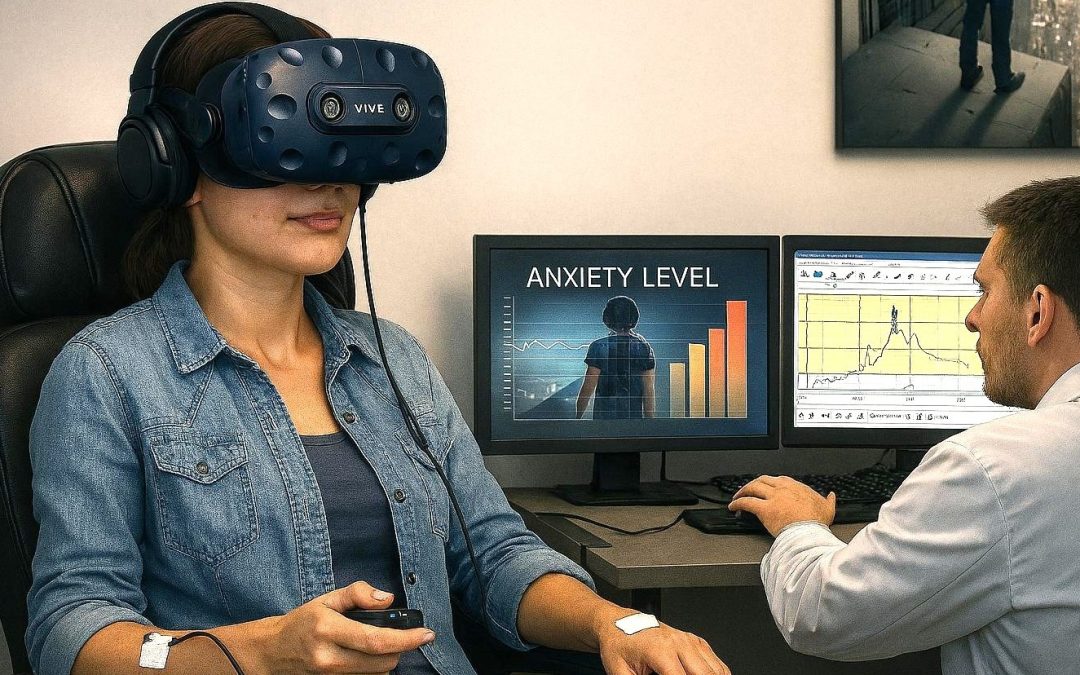
Researchers at the University of Cyprus investigated whether a single session of VR exposure could meaningfully reduce public speaking anxiety in university students. Participants were placed in a virtual auditorium and asked to give a speech in front of realistic virtual audiences. The researchers could adjust audience size and behavior, allowing them to gradually increase the social challenge while maintaining full experimental control. To capture objective stress responses, heart activity was recorded using a Lead I electrocardiogram configuration, with two disposable silver/silver‑chloride electrodes placed on the forearms. Signals were amplified with a BIOPAC ECG100C bio‑amplifier, acquired using a MP data acquisition system with AcqKnowledge software for recording and analysis. This setup enabled precise measurement of heart rate and heart rate variability (HRV) throughout the task. The virtual environment was created using the Vizard Virtual Reality Toolkit, which was integrated with the BIOPAC system so that physiological data could be synchronized with key moments in the VR experience, such as the start of the speech. Results showed significant reductions in both self‑reported anxiety and physiological arousal following a single VR exposure session, demonstrating how VR and physiological monitoring can be combined to assess rapid emotional change.
Researchers at the University of Macau examined how social rewards and emotional cues influence anxiety during interpersonal interaction. Participants engaged in a virtual reality social interaction game designed to mimic real social exchanges while allowing researchers to control feedback and outcomes. During the task, heart activity was recorded using ECG with an MP data acquisition system. By synchronizing physiological data with events in the virtual environment, the research team could examine how anxiety‑related responses evolved as social interactions unfolded. The findings suggested that anxiety responses were more strongly related to sensitivity to others’ emotional cues than to reward outcomes themselves. This study highlights how immersive VR combined with synchronized physiological recording can provide insight into the subtle emotional dynamics of social anxiety, processes that are difficult to capture using self‑report measures alone.
 In a multi‑institutional effort led by researchers at the University of Toledo, researchers developed a study protocol to better understand how dental fear develops and how early exposure might help prevent it. The study uses a virtual reality dental clinic to expose participants to dental‑related sights and sounds across multiple sessions and contexts. The virtual environment was programmed using Vizard software, and participants interacted with it using an HTC Vive Pro headset and handheld controllers, allowing natural movement and exploration. Skin conductance responses (SCR) were recorded using a BIOPAC MP system paired with a wireless BioNomadix EDA transmitter, enabling participants to move freely while skin conductance and other signals are collected. This wireless, immersive setup is especially well suited for fear‑learning research, where comfort and natural movement are critical. Although the publication focuses on study design rather than completed outcomes, it demonstrates how VR combined with physiological monitoring can support translational research aimed at understanding and preventing the development of fears and anxiety.
These studies show how VR and synchronized physiological measurement are expanding the study of anxiety, stress, and fear. VR provides immersive, repeatable experiences that reflect real‑world challenges, while physiological signals reveal how the body responds beneath conscious awareness. For additional information on how to integrate VR into multimodal research, visit our Webinar page for instructive trainings on this topic and others.
If you are planning to integrate VR into your next multimodal study, reach out to our skilled sales staff who can assist you through each step of the process.